In DeltaProduct (Siems et al., 2025), they propose to improve DeltaNet (Yang et al., 2025) by updating the online memory with
Introduction
DeltaNet
We use row-vector notation.
The update rule and query rule of DeltaNet can be written as:
where \( q_t, k_t, v_t\in\mathbb R^{d} \) are the query, key, and value vectors at time
This gives us the update rule:
DeltaProduct
DeltaProduct extends DeltaNet by generating
Equivalence to Variants of Multi-Head DeltaNet
Since we are generating
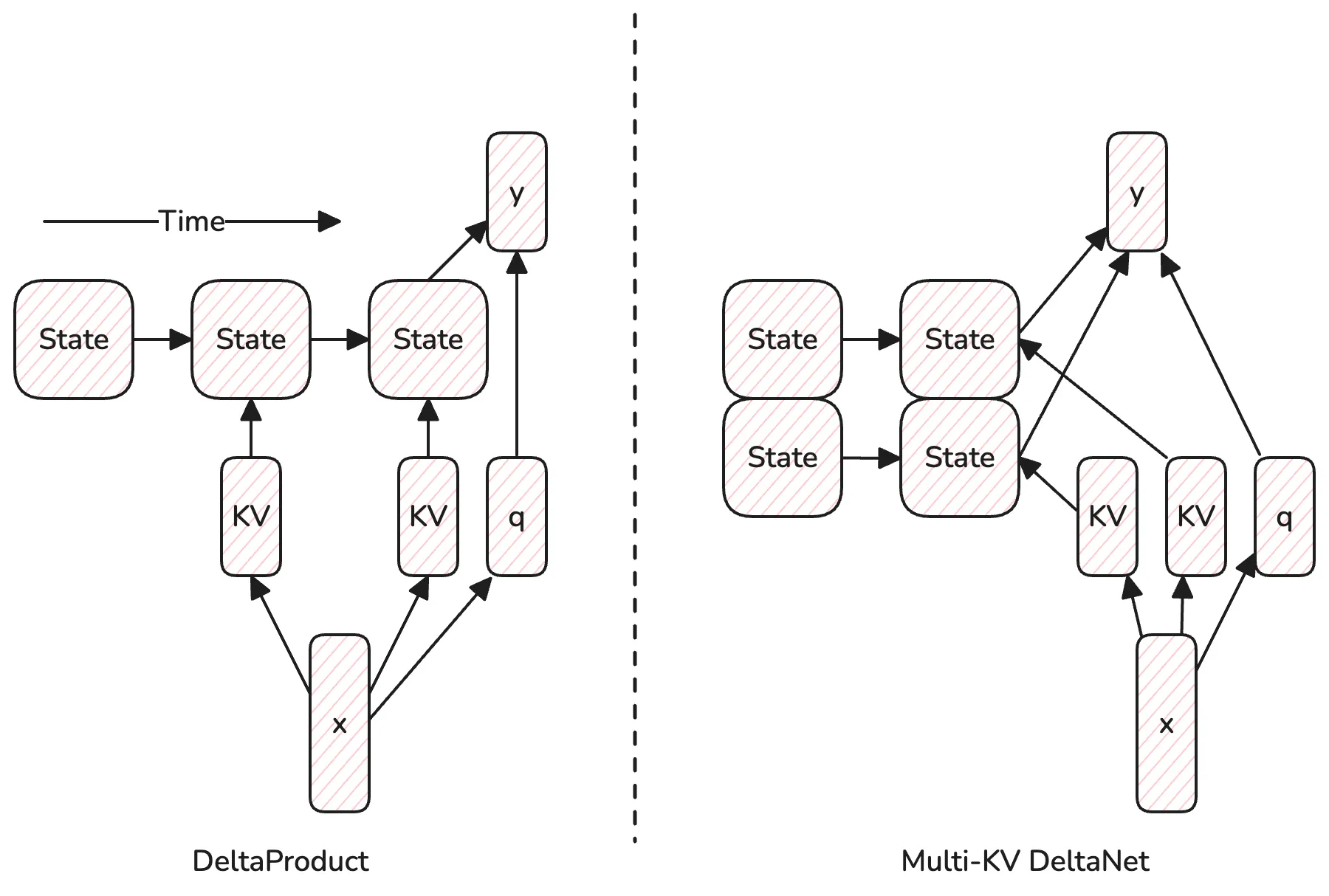
In DeltaProduct, there is only one query. So DeltaProduct is more similar to a version of multi-head DeltaNet where the query is shared among the heads, namely, the Multi-KV DeltaNet.
This is still not exactly the same as DeltaProduct, because in DeltaProduct, different KVs are inserted into the same state (in a sequential manner), while in multi-head DeltaNet, different KVs are inserted into different heads. In other words, different heads in DeltaProduct share both the query and the state. The following table summarizes the differences:
| Model | Queries | Keys | Values | State |
|---|---|---|---|---|
| DeltaNet | 1 | 1 | 1 | 1 |
| DeltaProduct | 1 | 1 | ||
| Multi-head DeltaNet | ||||
| Multi-KV DeltaNet | 1 | |||
| Multi-value DeltaNet | 1 | 1 | ||
| Multi-key DeltaNet | 1 | 1 | ||
| Multi-query DeltaNet | 1 | 1 | 1 |
To better illustrate the difference, I have drawn a diagram below:
The Potential Flaw in DeltaProduct
Many works have shown that recurrent architecture are bottlenecked by the state size. Hence, I think it is unreasonable to try to insert multiple KVs into the same state. So one potential improvement to DeltaProduct is to use untied states (i.e., different states for different KVs), which turns it into a multi-KV DeltaNet. Inspired by Mamba2, maybe it’s even better to use multi-value DeltaNet, which saves some parameters, thereby increasing the state to parameter size ratio.
How to Cite
@misc{chen2025delta-product,
  author = {Yingfa Chen},
  title = {Multi-Head DeltaNet},
  year = {2025},
  url = {https://chen-yingfa.github.io/2025/03/22/2025-about-delta-product/},
}
Feel free to contact me if you want to discuss this further.